A large sandstone bust of Dr. Francesco Franceschi sticks out of the hillside just west of the Franceschi Park parking lot. It faces the horizon and looks over the city below. For years it was easy to miss. A new trail now starts near the restrooms on the west side of the lot and takes you straight to it. Monique O'Conner, open space planner for the Parks & Recreation Department, called the bust one of the park's "hidden secrets" when she walked the grounds with the Santa Barbara Independent in late October.
The bust is one of several places the new trails reach. Taken together, the City's fall work points the park toward Franceschi's plants and the views across the hillside. The house at the top is where public attention has gone for years, and its future will take years to settle.
Where the new paths go
The City's Parks and Recreation Department announced the project on August 26, 2026 as a multi-week job to build more than 1,500 linear feet of new trail across the 17-acre park. By the end of October the trails were open. The new connections link:
- The parking lot and the Franceschi bust, by way of the trail that starts near the west-side restrooms
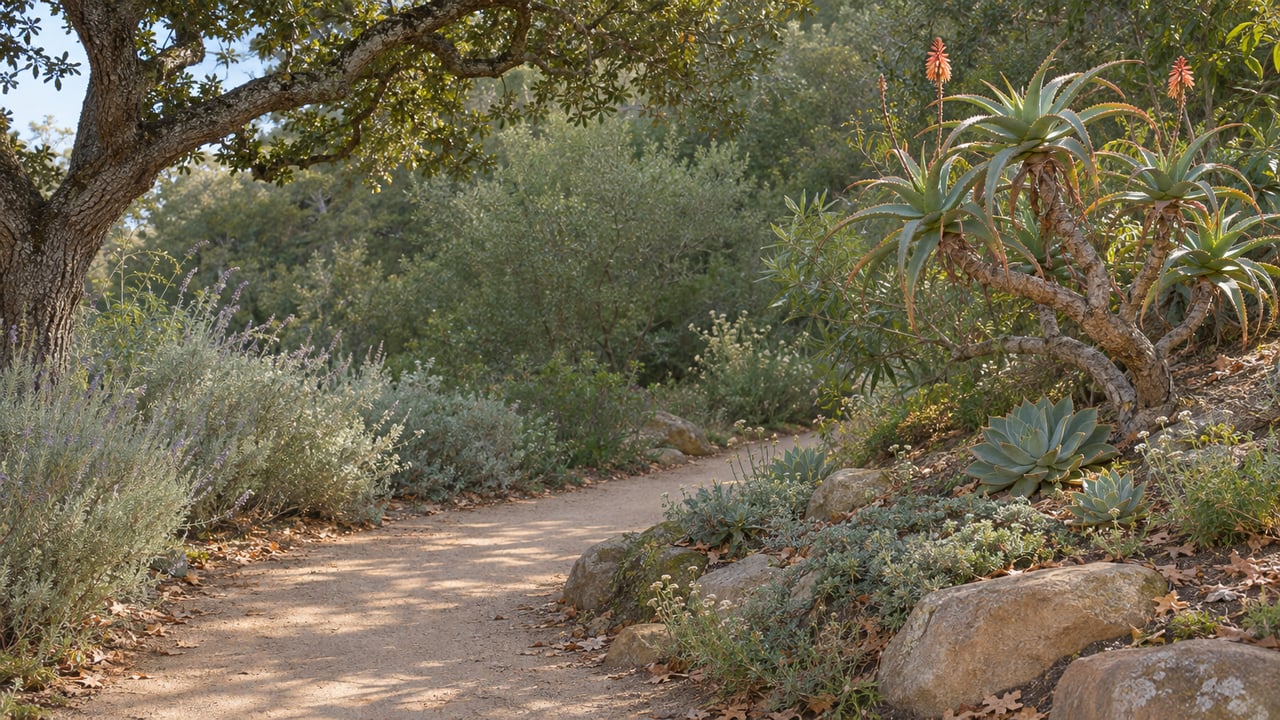
- The upper meadow, reached through eucalyptus, towering cacti and oaks, with views over Santa Barbara, Goleta and the ocean
- Upper and lower Franceschi, joined by hand-built trails so a walker can move between the two halves of the park without stepping onto Franceschi Road
- The lower slope, where new and repaired paths run past the Franceschi House and down the hill toward the Riviera
The Independent reported that most of these routes used to be "goat trails" before the City turned them into proper walking paths. Crews graded them on purpose to drain water and limit erosion. They also routed them to keep clear of oak roots, and they patched cracked or crumbling concrete walkways and stairs. Unsafe or redundant trails were closed and covered with natural materials so the hillside can grow back over them. The City also added three benches made from reclaimed wood, one of them in the meadow.
The trail work cost $77,000 from the City's General Fund.
The lower slope is the botanist's garden
Franceschi ran a nursery and botanic garden on this property from 1903 to 1913 and brought hundreds of exotic plant species into Southern California. Some of them still grow in the park. The Independent described the new lower route as a walk past the living remnants of that collection, including plants found nowhere else in the city.
Before the trail work, much of that slope was hard to see. Tree spurge, Euphorbia dendroides, had grown so tall and dense on the lower areas that it pushed out native plants and blocked the horizon. Clearing it took four months of full-time work. A $113,000 Coastal Conservancy grant paid for it through the City's Wildfire Resiliency Project, a program that restores native habitat. That grant is larger than the trail budget. The bigger share of the fall money went to the plants.
In the meadow, crews removed young eucalyptus that had been spreading in and left the mature trees standing. O'Conner told the Independent that native sage scrub is already coming back.
This focus on the plants matches a view the City's historic reviewers stated earlier in the year. At the January hearing on the Franceschi House, architect and Historic Landmarks Commissioner Robert Ooley told the Independent that the park honors Franceschi for his horticulture, not for a building that was heavily altered after his time.
"The value of Franceschi is not in the house." Robert Ooley, Historic Landmarks Commissioner, speaking to the Santa Barbara Independent
He also told the paper that the plants Franceschi set out will not last forever, and that keeping his vision alive means replacing them carefully as they age. Clearing the spurge and seeding natives this fall is the first step in that kind of upkeep.
What the ground looks like after the work
On parts of the hillside, the work is still visible. Crews hydroseeded the slope by spraying native seed and fertilizer with what amounts to a fire hose. The mix was dyed a nontoxic blue so they could see where it landed, and the dye fades within one to two weeks. Wattles, which are tubes of natural material that hold soil in place, are set around the park until the new plants fill the bare patches where the tree spurge came out. Container plants will also go into areas that were cleared.
O'Conner told the Independent the trails held up well after the recent rains. She also expects gophers to keep surfacing along the new paths for about a year before they move on. The seed mix is made up of native species that can be trimmed with a string trimmer. The City's August notice said more native habitat restoration would begin in winter.
The restoration also reaches beyond the park boundary. The Parks and Recreation Department is mailing neighbors information on removing tree spurge from their own properties. "They're kind of pretty, but pretty crummy for habitat," O'Conner told the Independent. The mailers come from the same department that cleared the lower trails.
The house runs on a slower clock
While the paths around it were rebuilt in a single season, the Franceschi House is years from a final decision. The Reimagining Franceschi House project page tells the history. Franceschi built a redwood Craftsman home here in 1905 and called it Montarioso. Alden Freeman bought the property in 1926 and turned the house into the Italianate villa that stands today. In 1931 he gave it to the City as a public park. The City designated the house a Structure of Merit in 1982, a status that requires historic review but falls short of full landmark protection.
| Milestone | What happened |
|---|---|
| 2018 | City Council voted unanimously to replace the deteriorated house with an open-air pavilion, a decision supported by the Pearl Chase Society |
| 2024 | Community outreach; feedback strongly favored a structureless overlook |
| June 26, 2025 | Parks and Recreation Commission approved removing seven trees, with 17 replacement trees required |
| January 14, 2026 | Historic Landmarks Commission concept review; project continued indefinitely, with no final decision |
| October 6, 2026 | Council authorized an amendment to the City's agreement for environmental consulting and documentation |
| 2028, tentative | Final planning permit and design approvals; construction documents prepared |
The current concept would take the house down and build an interpretive garden terrace on its footprint. The plan includes a 19-foot-wide terrace with a standing wall to display some of the house's 85 decorative medallions. The house also has stained-glass windows, an ornamental stairway, a small fireplace brought from New Jersey, and three sculptural herms by Ulrich H. Ellerhusen. The concept also adds accessible parking and paths, retaining walls, interpretive signs and improvements to the view perch.
The January vote by the Historic Landmarks Commission did not approve demolition or construction. Commissioners let the design keep moving and asked that the medallions and other architectural details be documented or worked into the terrace. According to the Independent, the terrace cannot hold all 85 medallions, and what happens to the rest is still undecided. Ooley suggested storing them, documenting them, or placing them along the park's walking paths as interpretive pieces.
The City says no construction money is allocated, and costs will be estimated after design and environmental review are finished. The Independent reported that if construction is approved, it could happen in phases over several years. As a result, for at least the next several years, the park you can visit is the one this fall's crews rebuilt: the bust, the meadow, the cactus-lined paths and the botanical slope below the house.
Getting there and timing a visit
Franceschi Park is at 1501 Franceschi Road. The lot is free and dogs are allowed on leash. According to the City's park rules, the park opens at 8:00 a.m., and city parks generally close half an hour after sunset. The lot is locked every night, and any car still inside after closing stays there until morning. Because closing follows sunset, the park closes earlier in late fall than in summer.
The bust trail starts at the restrooms on the west side of the lot. From there you can reach the meadow and then the lower trails, with the reclaimed-wood benches along the way. Expect bare ground and erosion wattles on the slope for now while the native seed comes in.
If you live below Franceschi Park and want to understand how changes like this restoration and the eventual house decision play into a Riviera property, Amanda Watkins follows the neighborhood closely and is glad to walk through it with you. Let's Connect.